The next version of thinkwell.tech, for review. Not live yet. See the live site

Skip to the page

Use Cases

The moments that decide the work.

Industries say who Thinkwell is for. Use cases say when it pays off: the moments your team already knows, what Thinkwell does in each, and the real numbers behind them.

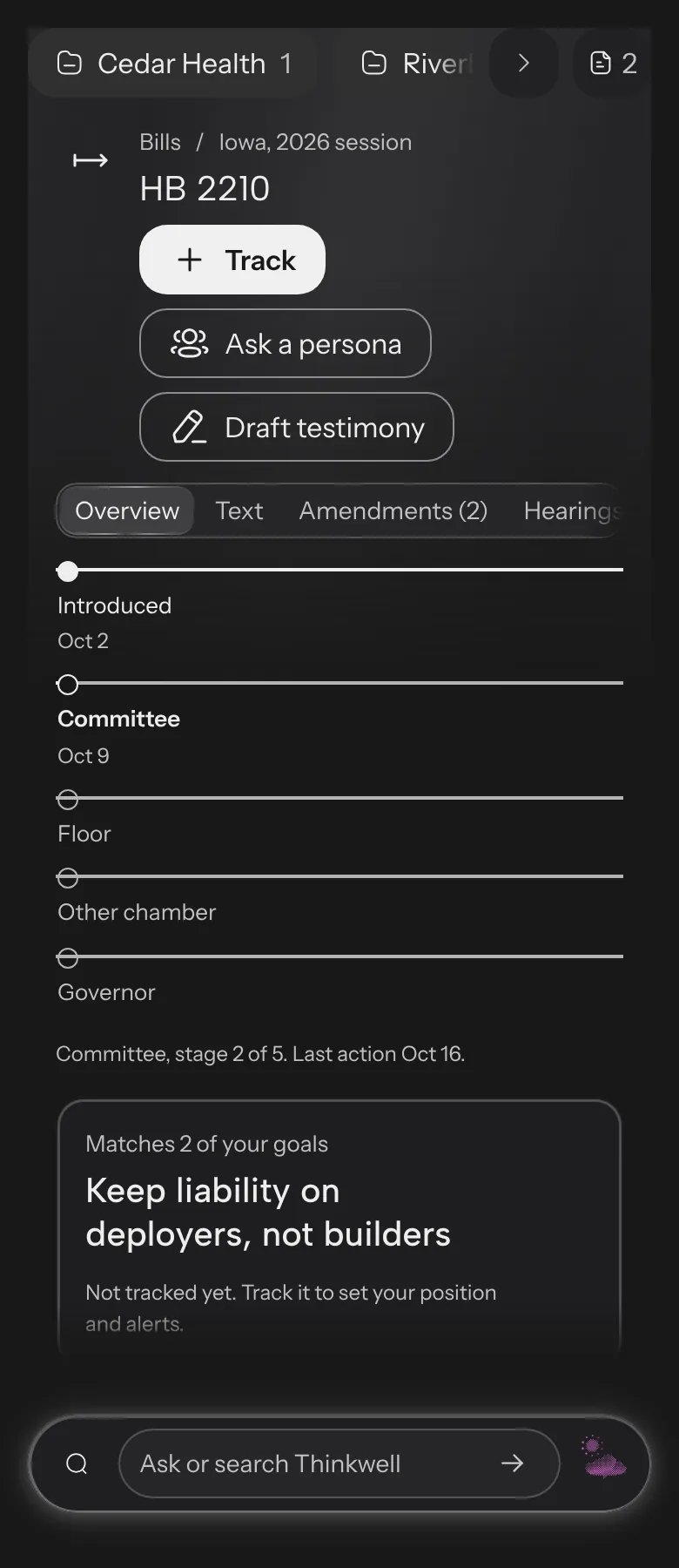
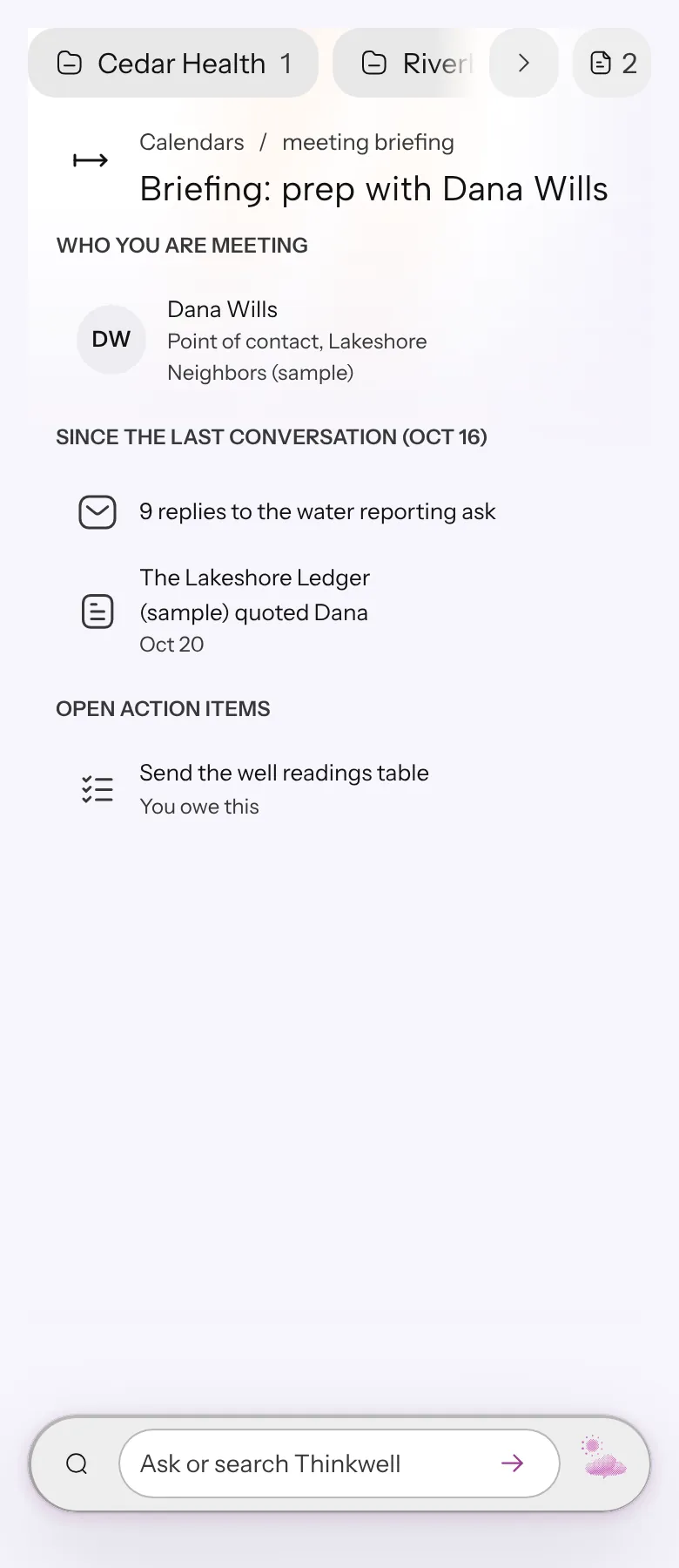
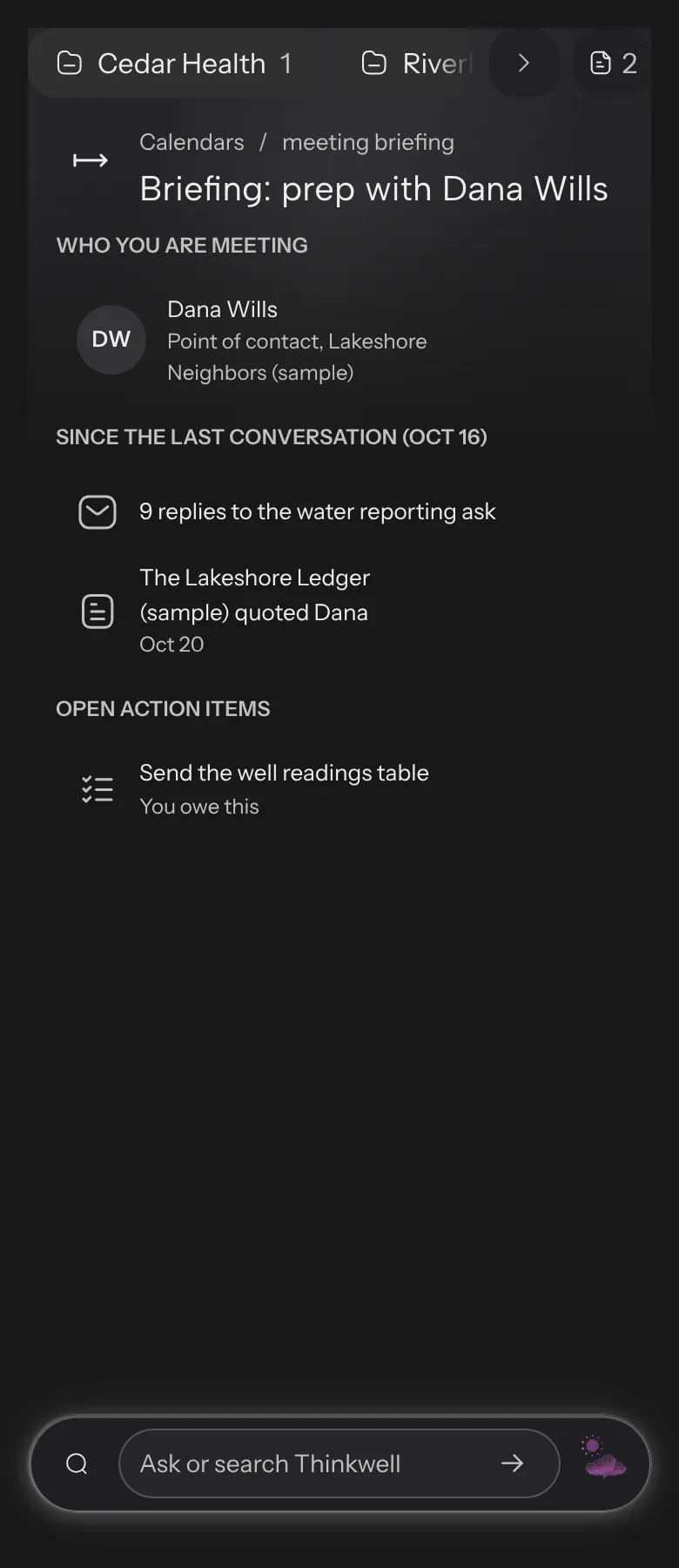
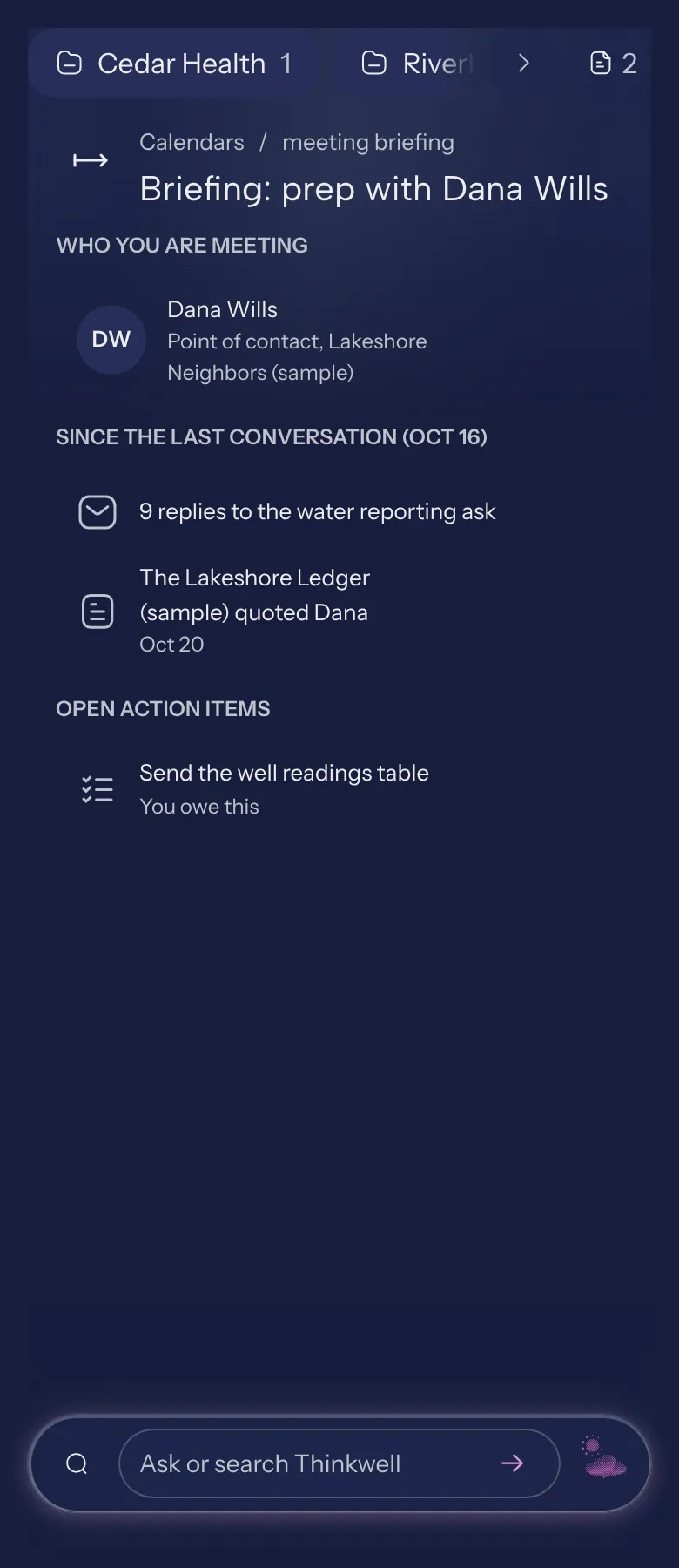
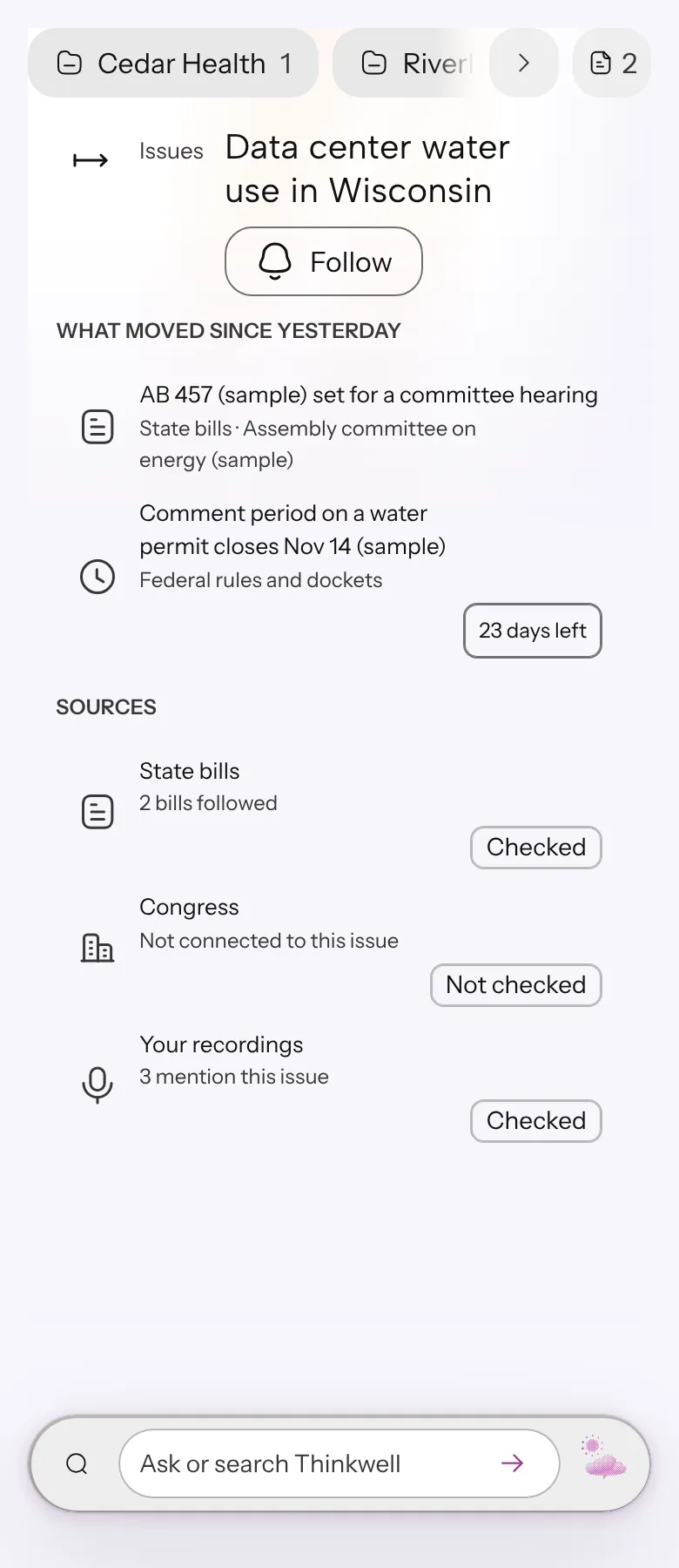
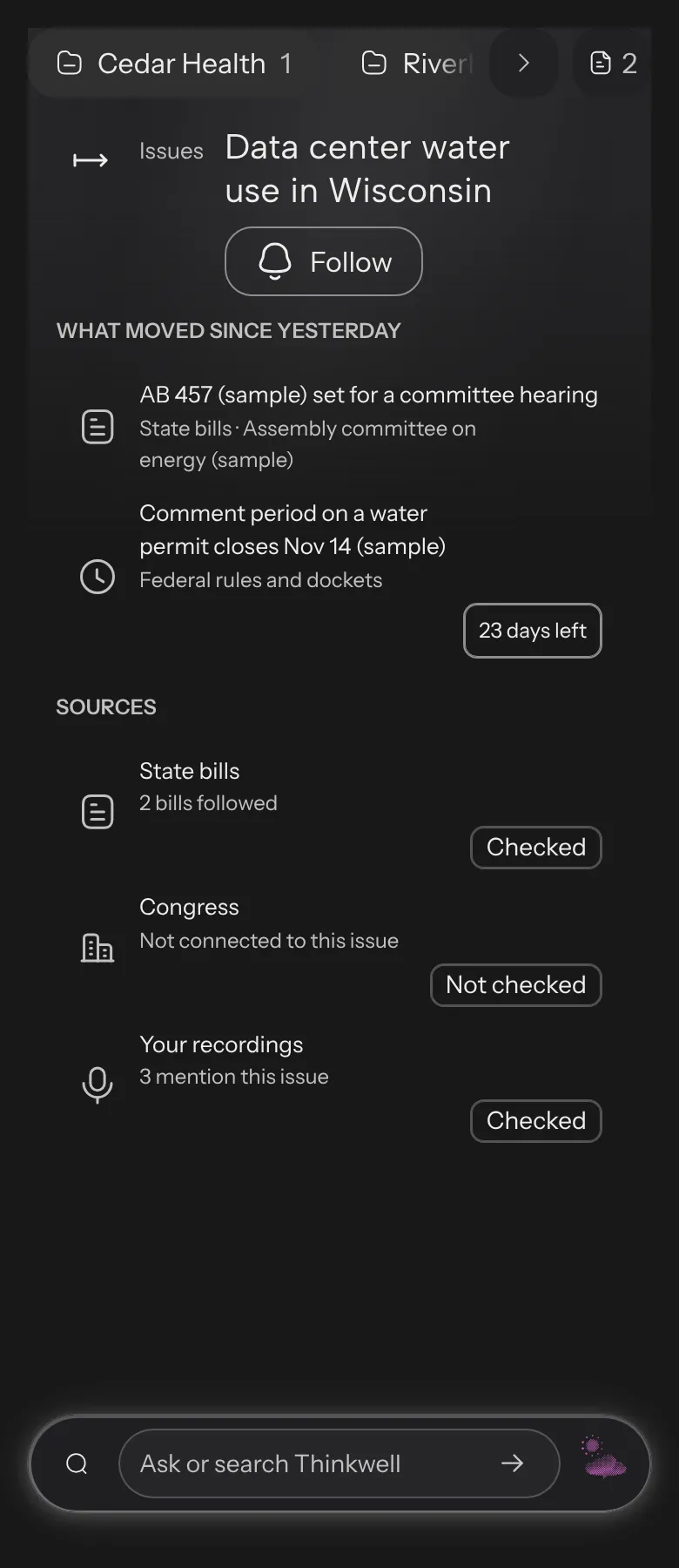
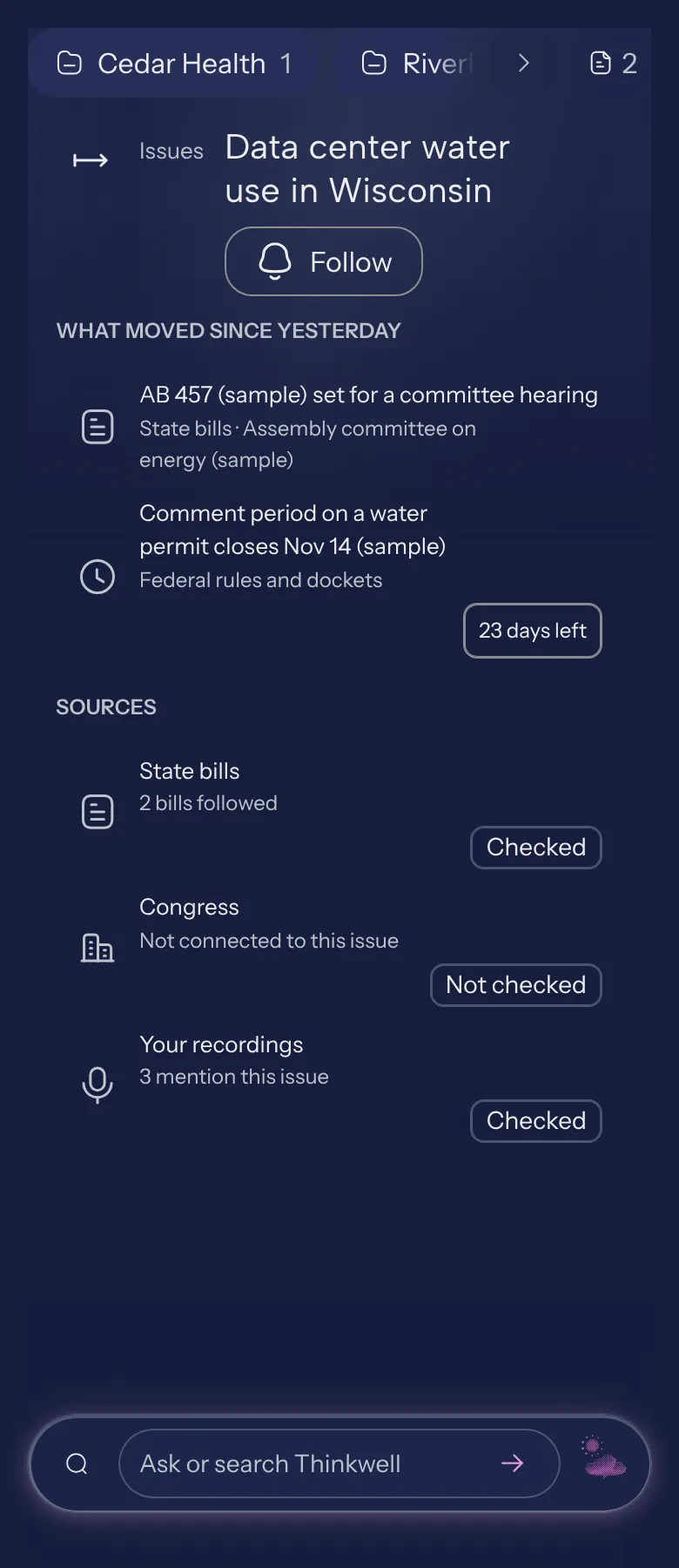
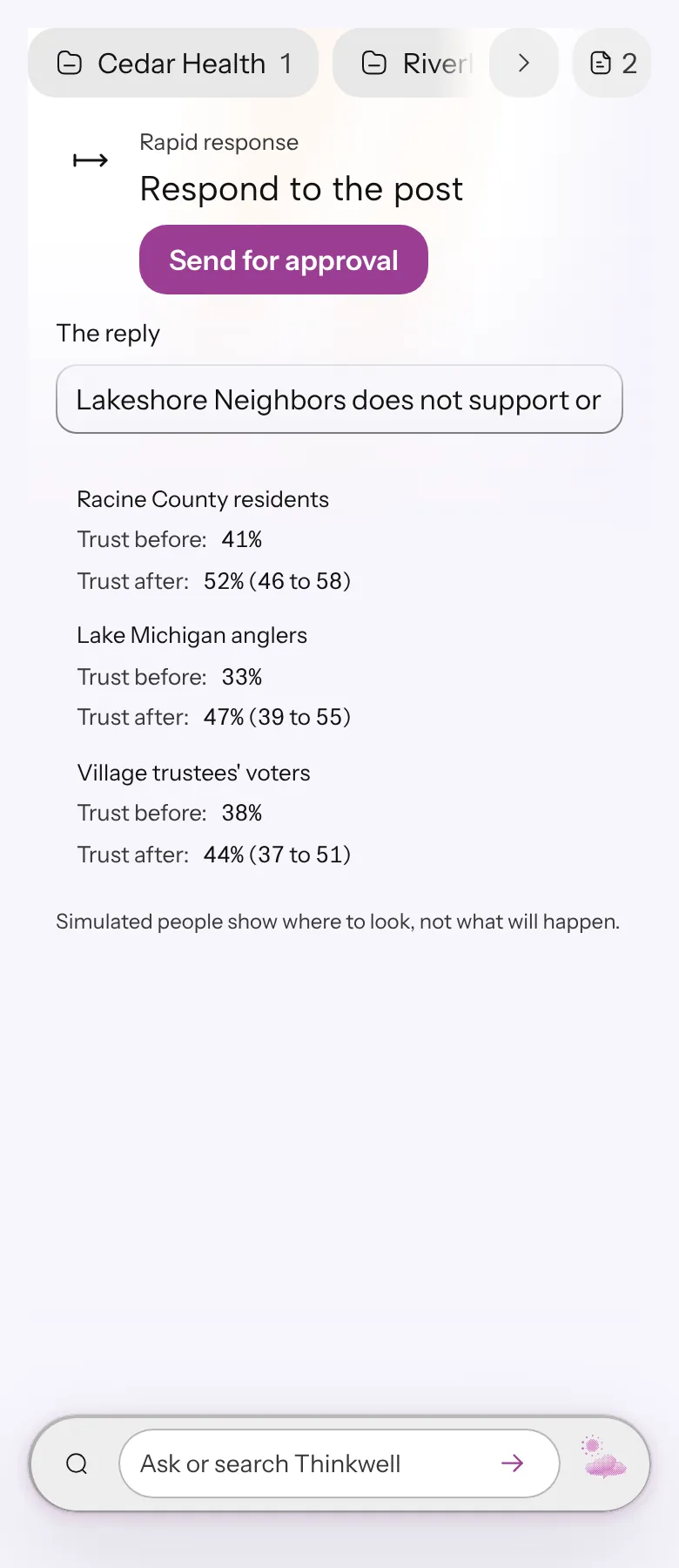
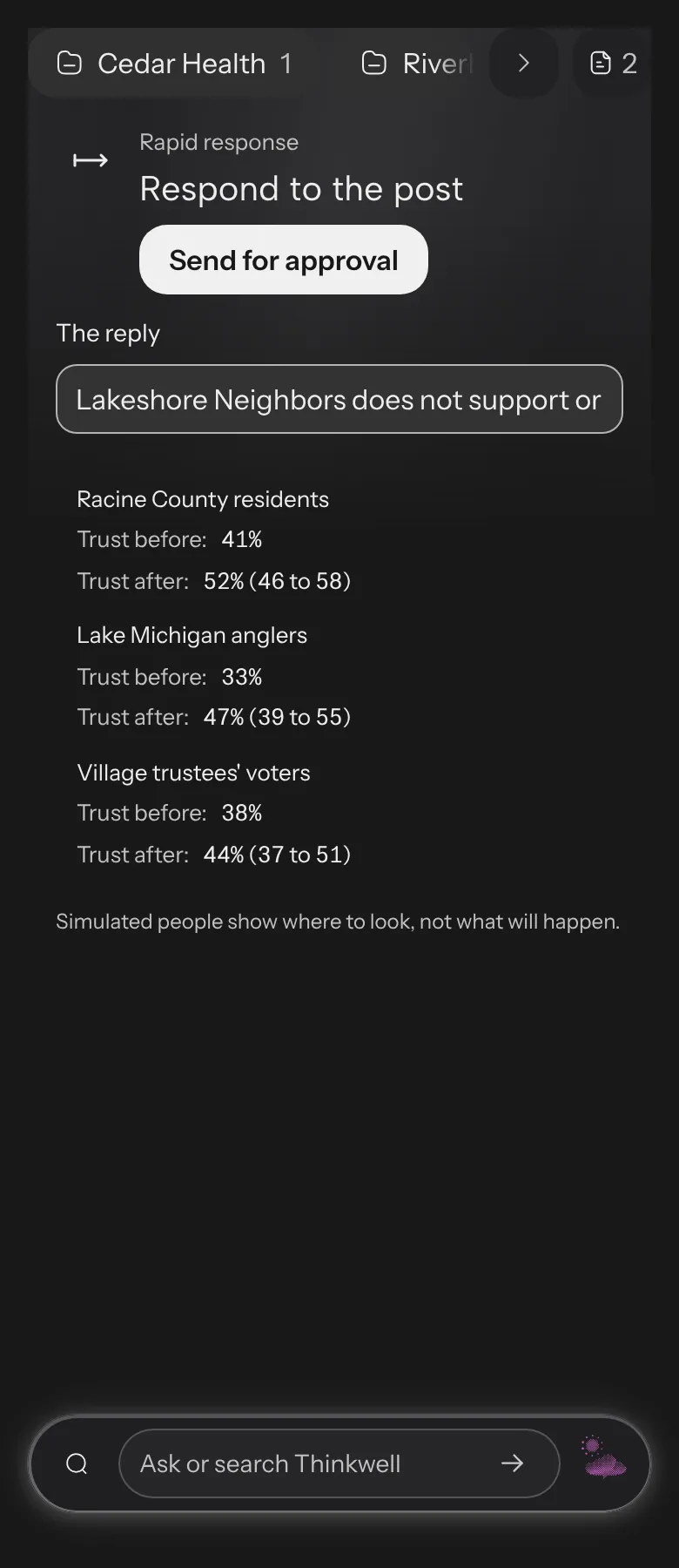
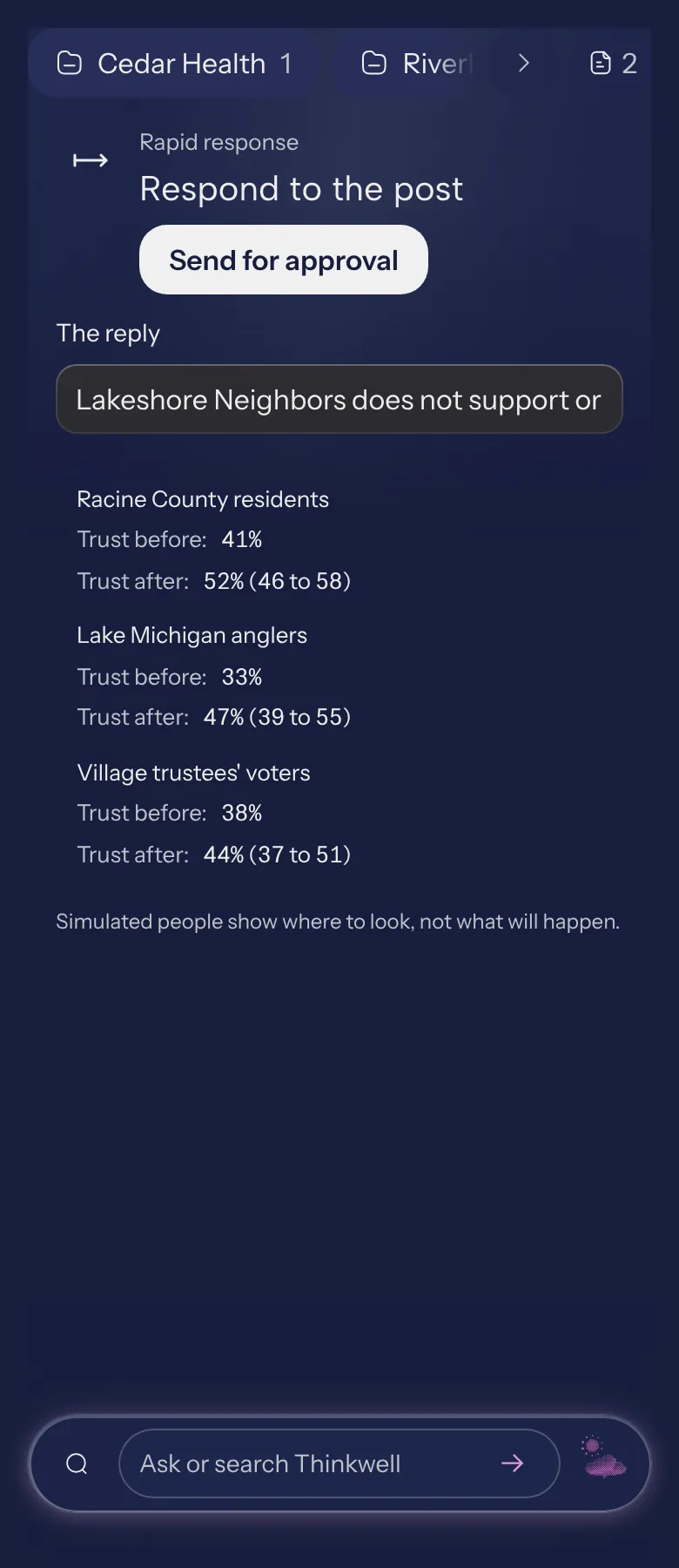
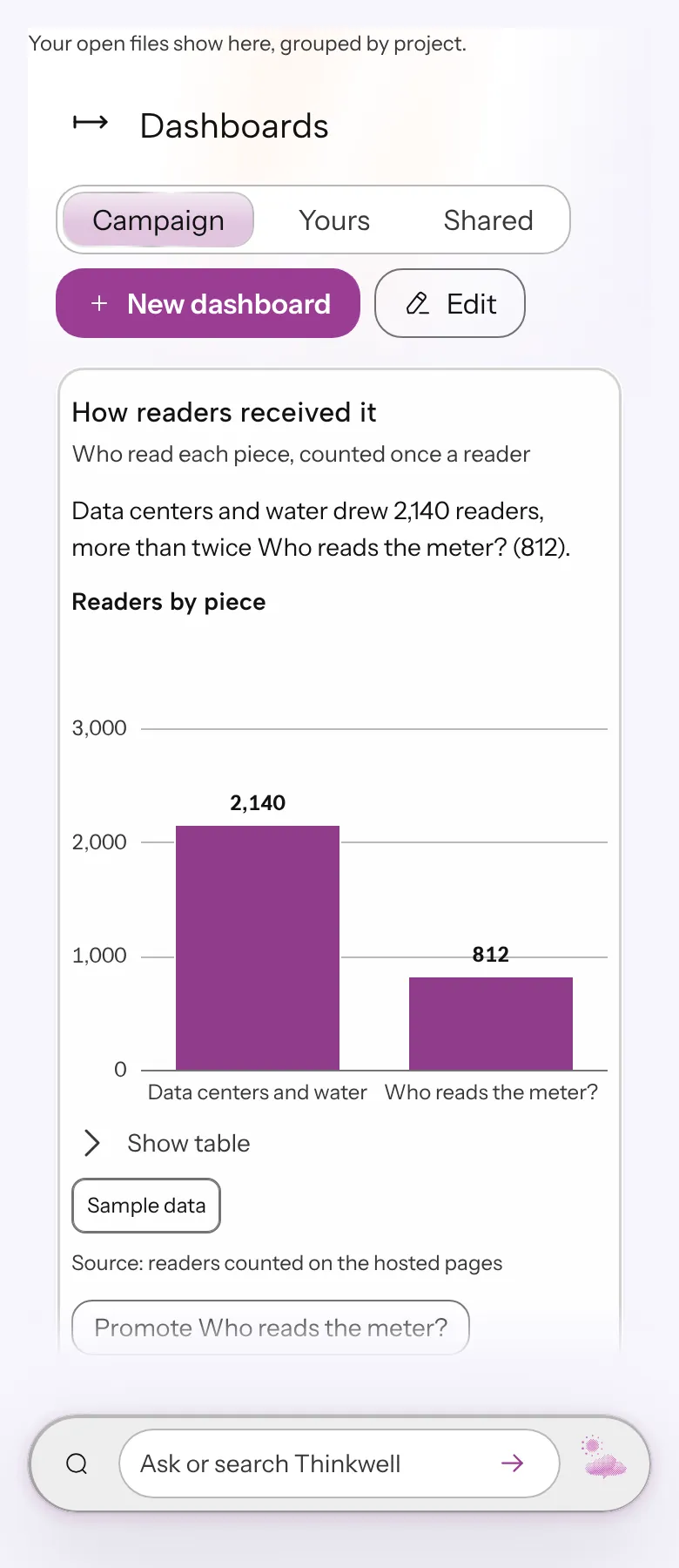
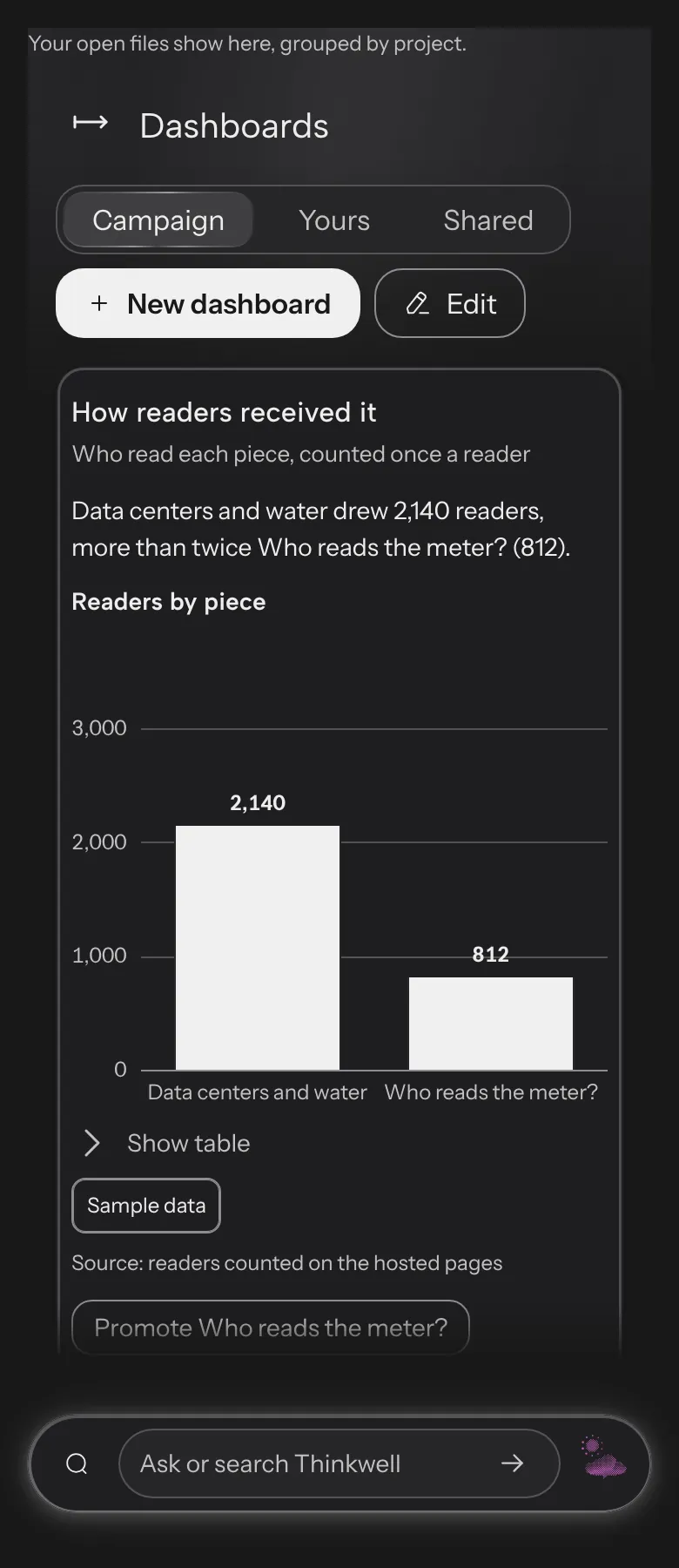
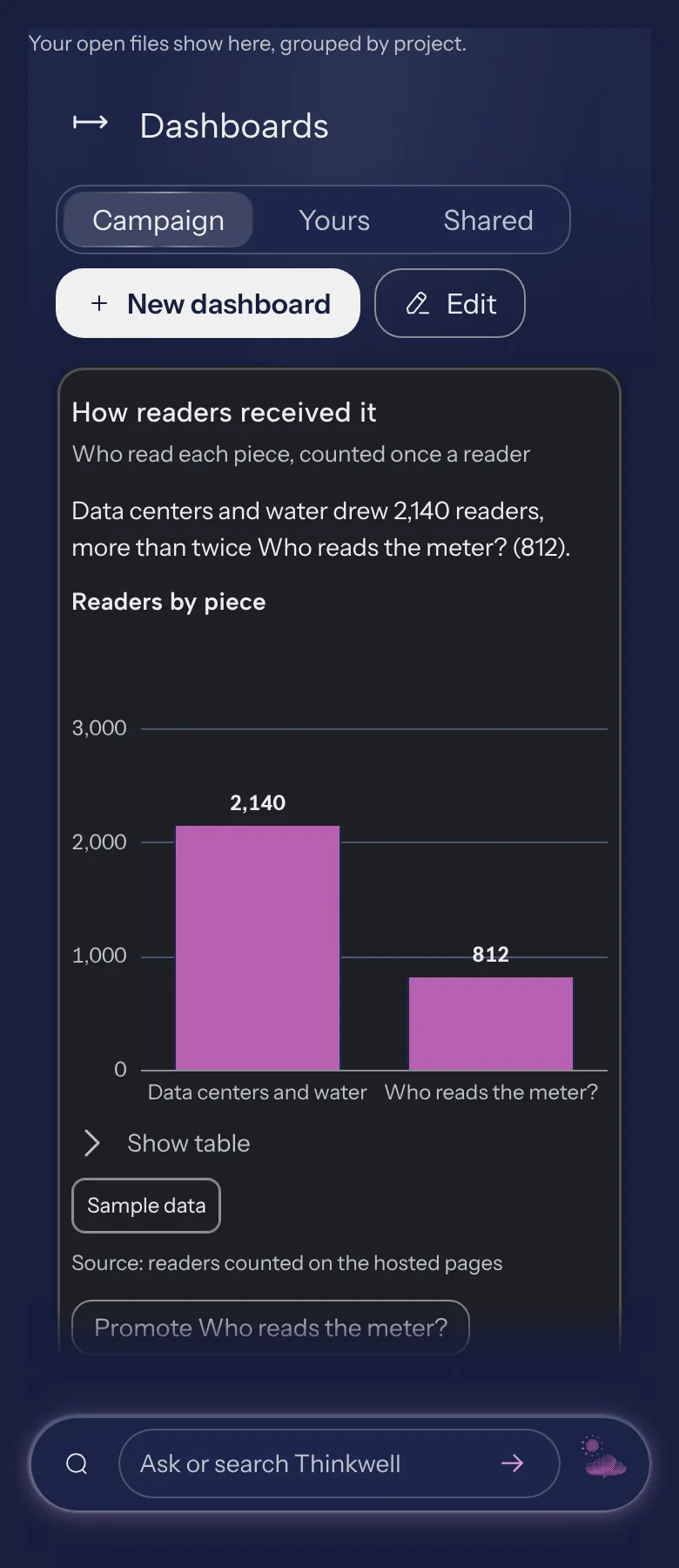
Sample One issue, from the morning’s moves to the client’s dashboard. The loop shows the real screens, with sample data, in turn: An issue’s page: what moved since yesterday. A bill’s page: where it stands and who holds it. A meeting briefing. A rapid response tried on simulated audiences. A dashboard where every number names its source.

Pick a moment.

The moment

Government relations

The day a client’s bill is referred to committee.
  • 19,841 bills introduced in this Congress. Nobody reads them all.Congress.gov, read Nov 9, 2026
  • 1,339 committee seats in Thinkwell’s record, across all 100 senators and 437 House members and delegates.Thinkwell’s record of Congress, counted Nov 17, 2026
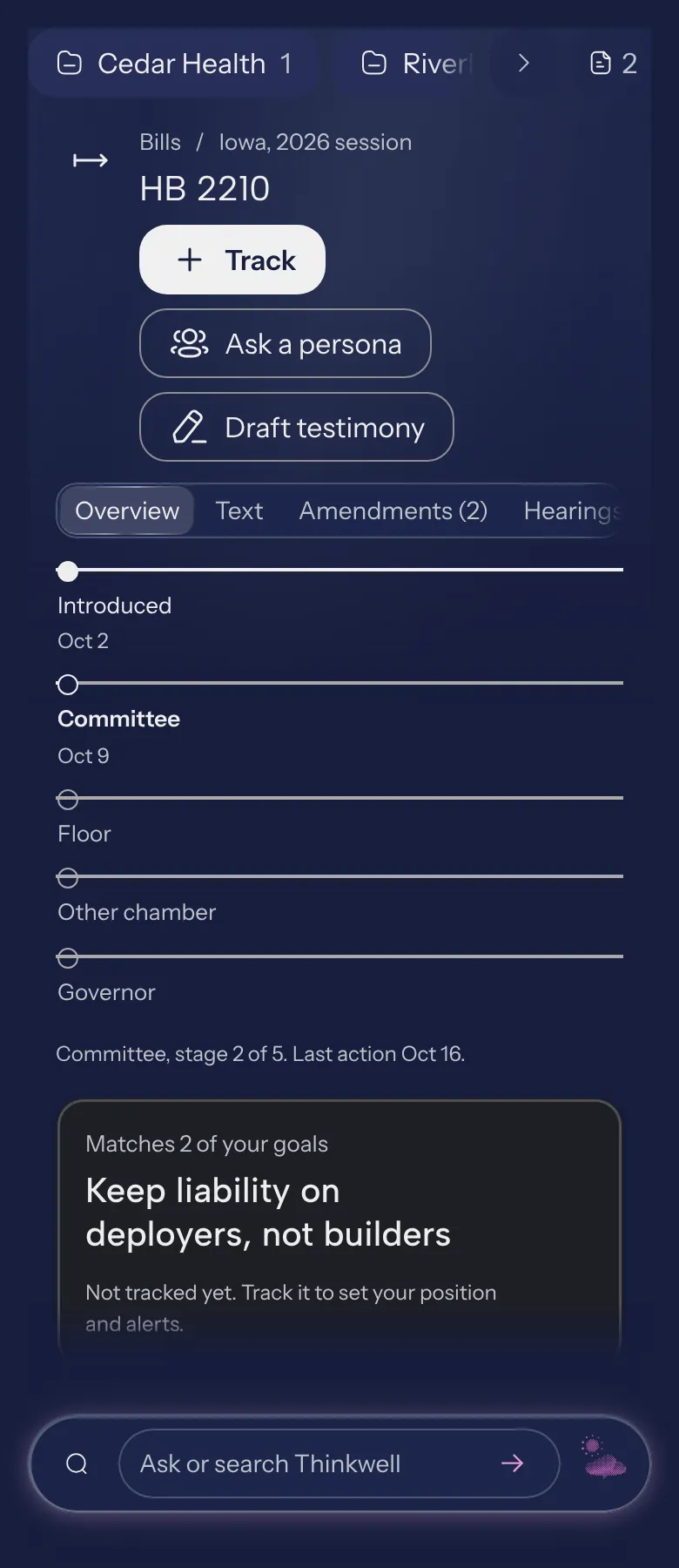
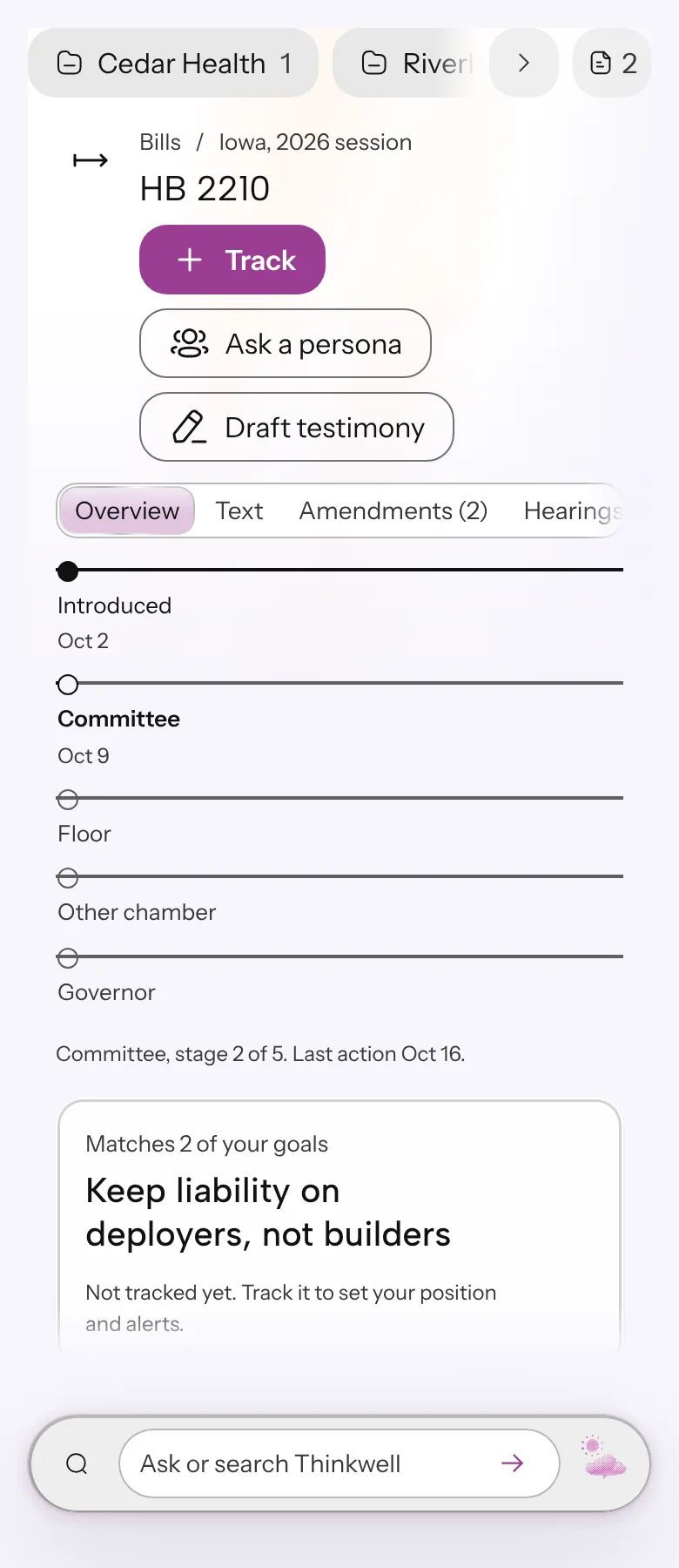
Thinkwell showing a state bill’s page: its stage on a track from introduced to governor, the goal it matches, the bill in plain words, what changed, and its stakeholders by role.Thinkwell showing a state bill’s page: its stage on a track from introduced to governor, the goal it matches, the bill in plain words, what changed, and its stakeholders by role.Thinkwell showing a state bill’s page: its stage on a track from introduced to governor, the goal it matches, the bill in plain words, what changed, and its stakeholders by role.
Sample A bill’s page: where it stands, what changed, and who holds it. The real screen, with sample data.

What Thinkwell does

Know who decides your bill before the first meeting is booked.

Your team starts with the members who actually hold the bill, not a list of 535 names.

  1. Name the billAdd it to the client’s Goal.
  2. The deciders come firstMembers of the committees that hold it lead your list, each with the reason.
  3. Open a profileParty, state, district, committees, and leadership role.
  4. Mark where they standFor, against, or undecided, with your team’s notes.
  5. See who moves themWho sways each undecided member, and your strongest way to each.

In Thinkwell™

  • Stakeholders
  • Stakeholder book

What you get

  • Your first calls go to the offices that hold the bill.
  • No committee rosters to build by hand or keep current.
  • One list the whole team works from, with its stance on each member.

Why you can trust it

Each bill’s committees come from the official bill status record, refreshed daily.

Needs

ProEnterprise

Hearings and markups on your calendar add the Government add-on.

The connected record

It already knows who decides.

Most tools hand you a list of names. Thinkwell connects the people in power to the bills they hold, the money behind each position, what is being said, and your team’s own relationships, so every answer starts in the right room.

senators, with party, state, and committees
100
House members and delegates
437
committee seats, matched to the bills they hold
1,339
committees of Congress
46
quarterly lobbying reports since 2008
6,927
news outlets across the spectrum
47

Counted in Thinkwell’s record on Nov 17, 2026. Your own Stakeholders, notes, and relationships sit on top, and stay your team’s.

  • Start with the people who decide.

    The day a client’s bill is referred, the members of the committees that hold it lead your list, each with the reason they are there. No spreadsheet, no guessing among 535 names.

  • Find the warm way in.

    See who on your team already knows the office you need, how strong the tie is, and the record behind it, up to three introductions away. Thinkwell drafts the ask; you send it from your own mailbox.

  • See where everyone stands, and who moves them.

    For any bill, goal, or issue: who is for, against, or undecided, who sways each undecided member, and your strongest route to each.

  • Follow the money behind a position.

    A company’s lobbying, quarter by quarter since 2008, the firms it hired, and a firm’s client list, before you pitch the coalition.

  • Hear the argument, not just the volume.

    Coverage and posts are read for the claims on each side, and the strongest other side is drafted for you, so your reply answers what people actually argue.

  • Every answer shows its receipts.

    Every tie, briefing line, and report sentence names where it came from and when. A strength never appears without its evidence, and anything invented for a demo says Sample.

Three more moments.

Each one uses only what is built today.

  • Find the weak paragraph before a reporter or a staffer does.

    Test two versions on up to 50 simulated people from an audience you describe, paragraph by paragraph, and walk into the client review with the version that tested best, and the reasons why.Pro or Enterprise. A test is a hypothesis to examine, not a prediction.

  • Rehearse with the person you’ll face, built from their own record.

    A persona of the member or official, built only from their sourced public record, plays your opponent in Practice, and the coaching quotes your own words back to you.Pro or Enterprise.

  • Real input, on your own site, with a range you can defend.

    Questions, polls, and structured discussions on a campaign page of your own, with your moderation rules, closing with campaign scores and a report.Pro or Enterprise, with Engagement. Checks of who participants are are coming soon.

MeasuredMeasured, not sampled

  • 95%A blind second reading agreed with Thinkwell’s stance judge on 95% of 161 checked pairs. It never swapped a yes for a no.
  • 19 of 22Items in a sponsor-commissioned poll were worded toward the sponsor’s side, and the gap between the poll and what people said online followed that wording.
  • 69% vs 22%Top-level comments posted in a thread’s first 15 minutes reached its top quarter 69% of the time, against 22% for those posted 3 to 12 hours in.

Findings from one claim study, October 2026. Real people and real posts, checked blind. Not a guarantee.

RealReal data, with its source named

Public records like the ones Thinkwell works from. Each count says where it came from and when it was read, and refreshes once a day.

We’re proud of what we’ve built.

Thinkwell™ speaks for itself.

Literally.

See the workstation, explore a real workflow, and discover how Thinkwell can be configured for your organization.